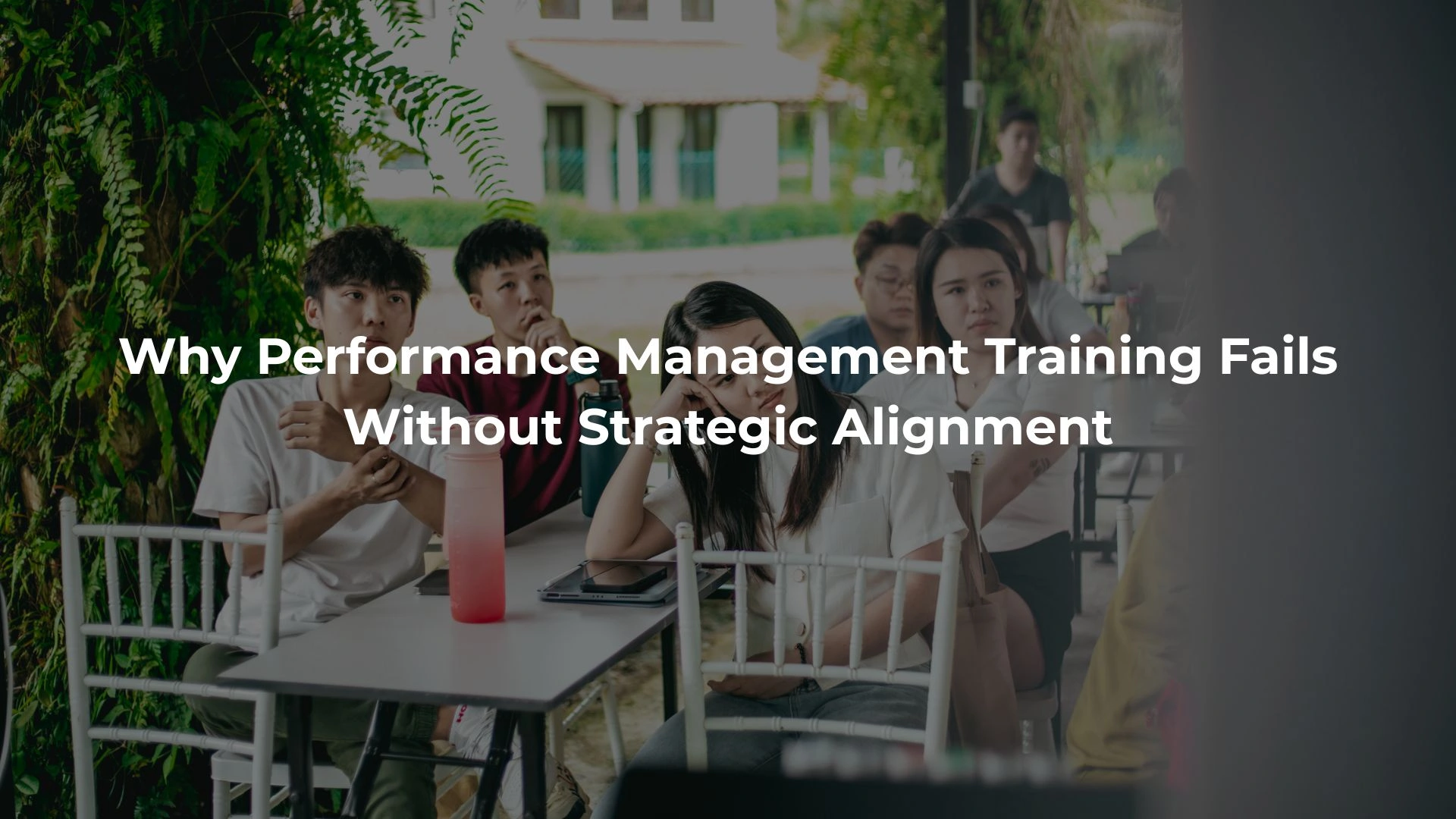
It is a corporate ritual enacted in offices across the world every mid-year and year-end: appraisal season. HR sends out the mandatory evaluation forms, middle managers frantically copy-paste generic feedback to meet the compliance deadline, and employees walk out of performance reviews feeling misunderstood, defensive, or entirely demotivated.
For most organizations, the annual appraisal is treated as an administrative chore, a bureaucratic box to be checked rather than a growth engine.
When performance scores do not translate into bottom-line growth, executives often assume the appraisal system itself is broken. They buy expensive new HR software or redesign the grading scales. Yet, the root cause is rarely the tool; it is the capability of the people using it. Without a deep connection to business strategy, standard performance management training fails because managers are taught how to fill out forms instead of how to coach human potential.
The fundamental reason most performance evaluation frameworks collapse is that they are treated as a retroactive "look-back" exercise. Managers use the appraisal meeting to litigate mistakes made six months ago, turning the conversation into a punitive blame game.
This compliance-first mindset creates intense psychological friction. When an employee feels attacked or hyper-evaluated on past failures, their defensive mechanisms kick in, shutting down any capacity for future behavioral change.
True performance management training must shift a manager’s perspective from being a retroactive judge to a proactive performance coach. The objective is not to document past shortfalls for the sake of the HR file; it is to establish a loop of continuous feedback that empowers the employee to course-correct in real-time. If feedback isn't happening weekly, the year-end appraisal is merely an expensive autopsy of organizational failure.
A common operational tragedy in growing enterprises is the "Siloed KPI" phenomenon. An HR audit might show that 95% of your employees met or exceeded their individual key performance indicators (KPIs), yet the company missed its macro strategic milestones for the year.
How can a team full of "A-players" produce a failing organizational result?
This disconnect happens when individual goals are completely isolated from the company's macro strategic "Lighthouse." When managers lack the strategic vocabulary to cascade corporate objectives down to departmental tasks, employees optimize for their specific metrics, even if those metrics cannibalize other departments.
To bridge this gap, managers must be trained in deep kpi alignment. They must learn how to show every employee exactly how their daily output directly accelerates or decelerates the organization’s high-level execution. When an entry-level executive understands how their micro-tasks affect the corporate P&L, their sense of accountability transforms.
High employee performance is never an accident; it is the byproduct of structured prioritization and energy management. Many managers mistake "busyness" for productivity, rewarding the employee who stays late over the employee who executes with quiet efficiency.
Before a manager can effectively evaluate a team member’s performance, they must first ensure the team is focused on high-leverage tasks. This requires an organizational mastery of focus.
This alignment between time and output is precisely why progressive companies are shifting how they train their leaders. By integrating advanced prioritization methodologies such as those explored in our specialized Workshop on Time Management managers learn to help their teams filter out operational noise and focus exclusively on vision-critical execution. Performance management becomes infinitely easier when both the manager and the employee are aligned on what truly matters.
At Vision Building, we re-engineer performance cultures by transforming middle managers from administrative paper-pushers into high-impact strategic facilitators.
Our performance framework relies on three interconnected execution pillars:
By implementing this systematic approach, you ensure that Corporate Training Drives Performance and Strategy simultaneously, transforming a dry HR mandate into a living, breathing competitive advantage.
Take a hard look at your organization's appraisal data from the previous cycle. If your managers are giving everyone high scores while your corporate growth remains stagnant, your performance ecosystem is out of alignment.
Your immediate next step is to evaluate whether your leaders are conducting retroactive administrative reviews or driving continuous feedback loops. To future-proof your organization's execution, you must equip your middle management with the coaching capability to connect daily human effort to your long-term business strategy. Discover how an Aligned Performance Management Strategy can unlock your team's true velocity.