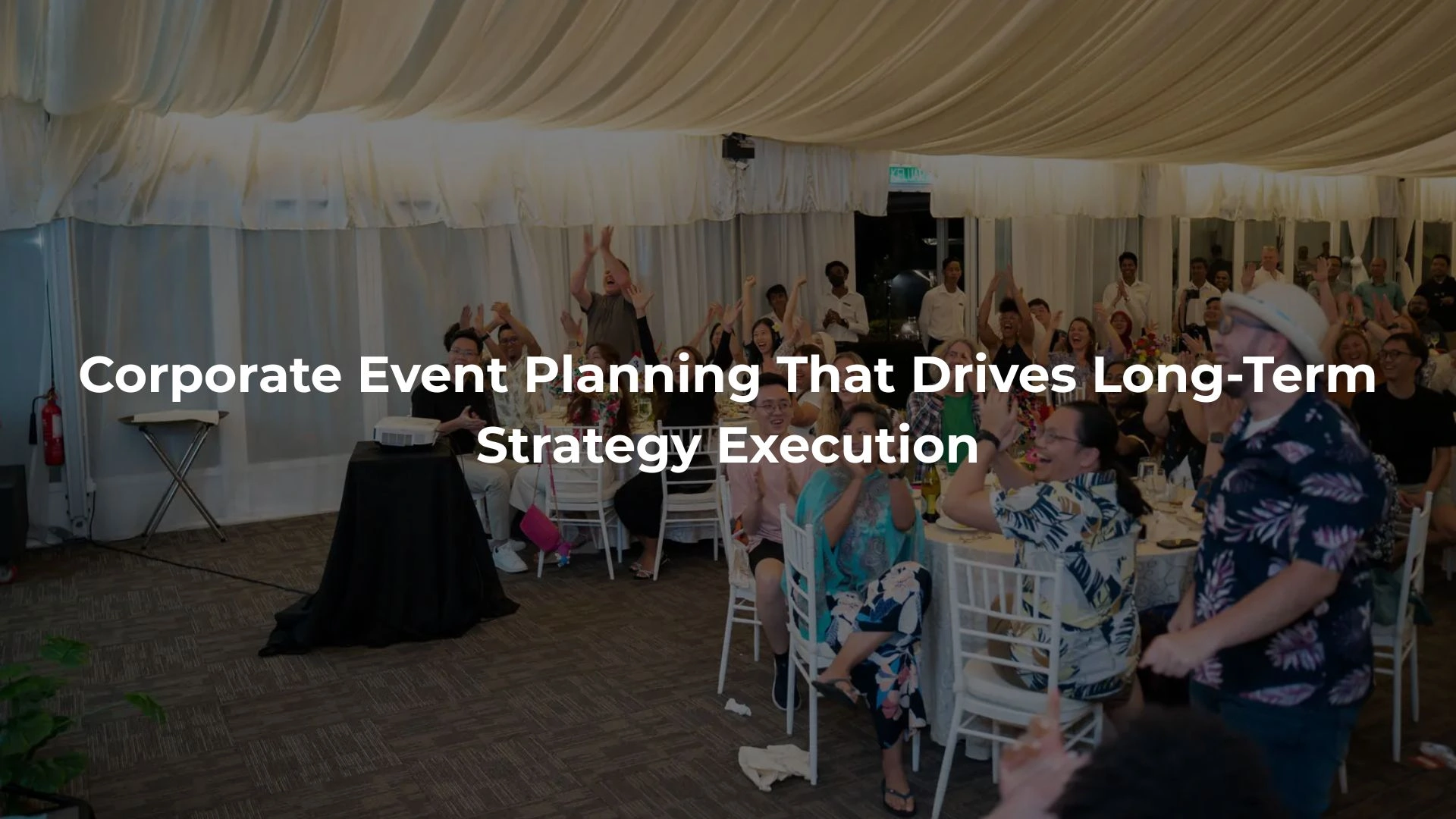
Every year, companies across Kuala Lumpur and Selangor dedicate a significant portion of their annual budgets to a familiar corporate ritual: the grand annual convention or the high-energy Q1 kick-off. Thousands of ringgit are spent on five-star hotel ballrooms, flashy LED backdrops, elaborate multi-course dinners, and high-end lucky draw prizes.
The immediate energy in the room is undeniable. The Managing Director delivers an enthusiastic speech about hitting new milestones, the team cheers, and the night ends on a massive high.
But if you walk into that same company two weeks later, a disturbing pattern emerges. The flashy slide decks have been forgotten, the strategic directives have collapsed back into daily operational fires, and employees are still working in the exact same siloed habits as before. The event was a spectacular entertainment success, but a complete strategic failure.
In the hyper-accelerated market of 2026, treating your major corporate gatherings as mere gala nights or dry financial reporting sessions is a massive waste of organizational leverage. Elite corporate event planning Malaysia firms must look past the logistical fluff. It is time to transform your annual milestones into high-impact alignment interventions that drive long-term strategy execution.
When a company plans a large-scale gathering, the responsibility is almost always handed over to an internal committee or a traditional event agency. Naturally, their primary metrics of success are logistical: Was the food good? Did the audiovisuals work? Did people have fun?
While these elements are important for baseline employee morale, they treat the event as an isolated party rather than a tool for corporate growth.
This is the hidden tragedy of the traditional kick-off meeting strategy. Organizations miss a pristine, high-leverage window where their entire workforce is physically and mentally gathered under one roof. Instead of using this collective focus to deeply anchor the company’s vision and build psychological alignment, they subject their teams to hours of passive, one-way information dumps or surface-level entertainment. You cannot build a unified culture through passive listening. Alignment requires active engagement.
To maximize your annual convention impact, the architecture of the event must shift from top-down broadcasting to interactive vision co-creation.
When your leadership team announces a bold new 2026 milestone on stage, the average employee in the audience is silently asking themselves one question: "What does this mean for my daily workload?" If that question goes unanswered, the strategy stays abstract, and execution stalls.
An elevated corporate event must bridge this gap. Every main-stage presentation must be paired with collaborative, interactive exercises that force different departments to break out of their usual circles and co-create their own execution roadmaps. When a frontline executive or a backend engineer actively maps out how their specific team will accelerate the new milestone, they stop being passive spectators of the company’s vision and become accountable co-authors of it.
Designing an event that permanently shifts employee behavior requires the exact same outcome-based precision as high-level organizational development. You cannot leave the cultural impact of your convention to chance.
Every interactive challenge, every panel discussion, and every team milestone celebrated on stage must be intentionally engineered to dismantle internal friction and reward cross-departmental collaboration. This necessary rigor is precisely why we argue that Why Most Team Building Objectives Fail to Reach the Boardroom because companies routinely fail to align their large-scale interactive objectives with their hard boardroom deliverables. If your convention activities don't explicitly mirror and solve your real-world office bottlenecks, they are just expensive distractions.
At Vision Building, we do not just plan logistics; we architect immersive cultural turning points. Our end-to-end event framework ensures that your gathering serves as an active catalyst for long-term operational velocity.
Our blueprint maps across three critical phases:
This holistic approach recognizes that true behavioral transformation is a continuous ecosystem. As we have deeply analyzed in our methodology on How Team Performance is Built Beyond Training Sessions, an event shouldn't be the final destination, it should be the launchpad for ongoing cultural evolution.
Look at the budget and planning timeline for your upcoming corporate kick-off or convention. If your current strategy places 90% of the focus on the venue, menu, and entertainment, your event is highly exposed to strategic drift.
Your immediate next step is to reallocate your planning energy away from pure entertainment and toward structured organizational alignment. Ensure that your main-stage content is translated into actionable behavioral goals for every tier of your workforce. Discover how a Vision-Driven Corporate Event Architecture can turn your next gathering into a highly optimized engine for long-term growth.