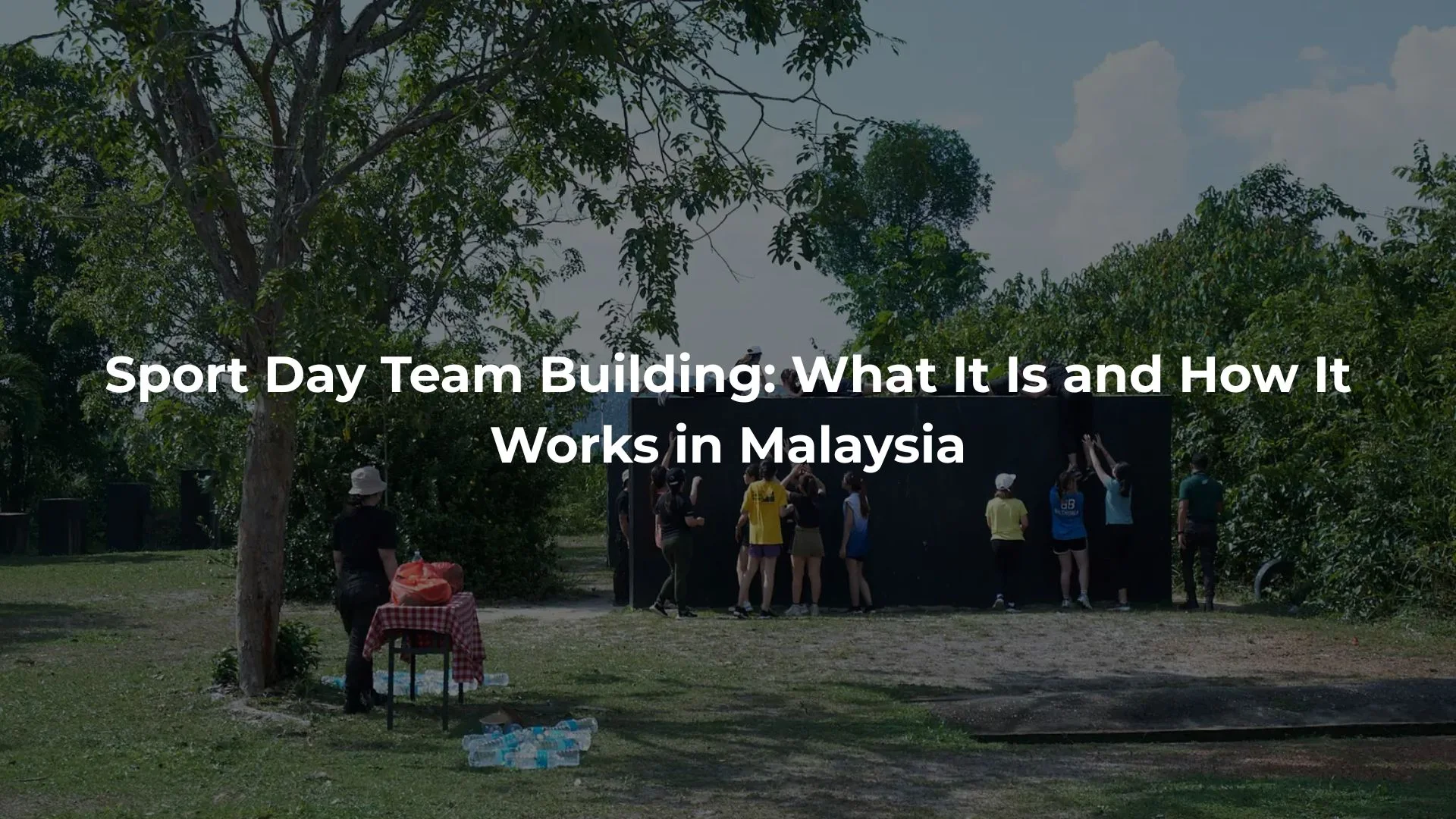
A corporate sport day is a structured, half-day to full-day team building format built around competitive physical activities — relay races, mini-Olympics style stations, tug-of-war, obstacle courses — organized into teams that deliberately mix departments rather than existing work groups. It's one of Vision Building's core team building programmes, built specifically for teams that need visible energy and culture activation, not a slow, reflective session.
That distinction matters more than it sounds. A distress session and a sports day can both be labelled "team building," but they solve opposite problems: one is designed to help a burned-out team exhale, the other is designed to get an energetic team moving, competing, and bonding through shared physical effort. Picking the wrong one for a team's actual mood is one of the more common — and avoidable — team building mistakes.
Vision Building runs Sport Days across Kuala Lumpur and Selangor as part of its wider team building suite, and this guide covers exactly what a sport day involves, how it's structured, and when it's the right call for a Malaysian corporate team.
A typical sport day runs through a rotation of stations — relay races, tug-of-war, mini-Olympics style challenges such as sack races or balloon relays, and team obstacle courses — each scored and tracked toward an overall leaderboard. Unlike a casual office sports afternoon, a corporate sport day is facilitator-led from start to finish: team assignments, scoring rules, station transitions, and the closing award ceremony are all planned in advance rather than improvised on the day.
The most important structural decision is how teams are formed. Teams are deliberately mixed across departments and seniority levels, so the finance team isn't just competing against the marketing team in their usual silos — colleagues who rarely interact day to day end up on the same relay team, which is where most of the actual team building value comes from, not the games themselves.
Most corporate sport days in Malaysia run for half a day, though a full-day format is common when paired with a larger retreat or when the group size is large enough that station rotations take longer to complete. A typical half-day agenda includes an opening briefing and warm-up, three to five rotating stations, a lunch or refreshment break, and a closing ceremony where the leaderboard results are announced alongside recognition for sportsmanship — not just the winning team.
Sport Day is one of six named programme categories Vision Building runs, and choosing the right one starts with matching the team's actual mood and objective, not the activity that sounds most fun:
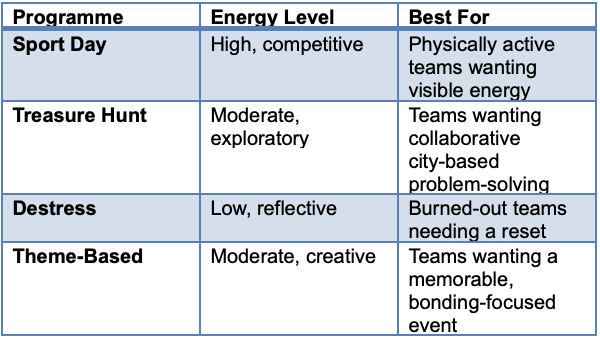
A company unsure which format fits can look at team energy first: a sport day is the right call when the team has the physical energy for competition and would get more value from moving and competing together than from a quieter treasure hunt or a destress-style reset.
Sport days work best for younger, physically active workforces — teams where a competitive relay race or obstacle course genuinely excites people rather than intimidates them. They're also a strong fit for companies specifically wanting a culture-activation event rather than a skills-training session: the goal is visible energy and shared competition, not a structured learning outcome.
A sport day can run as a stand-alone half-day event or as one component of a larger retreat or annual celebration. Companies planning a milestone year sometimes pair a sport day with an evening celebration, giving the day a natural arc from competitive energy in the afternoon to a more relaxed, social evening.
Companies newly formed from a merger or acquisition are also a strong fit for this format — a sport day gives two previously separate workforces a low-stakes, high-energy reason to interact for the first time, well before the deeper cultural integration work of a merger typically begins.
The detail that separates a genuinely useful corporate sport day from a generic office sports afternoon is how scoring works. Vision Building weighs scoring toward teamwork and sportsmanship — how well a team communicates, encourages weaker members, and recovers from a bad round — not purely athletic performance. This keeps the day inclusive for staff who aren't naturally athletic, and it reinforces the same underlying idea that runs through all of Vision Building's programmes: the outcome that matters is how the team behaves together, not who wins.
Stations are also rotated deliberately so that no single physical skill set dominates the leaderboard for the entire day — a station rewarding speed is balanced against one rewarding coordination or strategy, so different team members get a turn to shine. Sport Day programmes are HRD Corp claimable under Vision Building's standard programme structure, consistent with its other team building programmes.
Most sport days run on an outdoor field or a covered court, with the choice depending largely on group size and the season — Malaysia's wet season makes a covered or indoor-adaptable format worth planning for in advance rather than risking a rain-out on the day. Group sizes scale from a single department of 20-30 people up to full company events of 500 or more, with station count and rotation timing adjusted accordingly.
Vision Building's Corporate Events & Employer Branding coordination extends to sport day logistics as needed — equipment, referees or facilitators per station, first aid coverage, and hydration stations — so the day runs on schedule regardless of group size.
The single biggest factor in whether a sport day succeeds isn't the stations chosen, it's how well the team is briefed beforehand. Staff who arrive unsure of the dress code, unsure whether they're expected to participate fully or can opt for a lighter role, or unaware that teams have already been assigned tend to hang back rather than engage — which defeats the purpose of a format built around full participation.
A short pre-event communication covering appropriate footwear and clothing, hydration expectations, and a reassurance that scoring rewards teamwork over athletic ability specifically helps less physically confident staff show up ready to participate rather than dreading the day. Companies that skip this step often find a portion of the group opts out of the more physical stations, which narrows the cross-department mixing effect the format is designed to create in the first place.
Two questions come up in nearly every sport day scoping conversation. The first is what happens with staff who have physical limitations or don't want to participate in high-intensity stations — the answer is that every station has a modifiable version, and roles like scorekeeping, team captaincy, or refereeing are built into the day so no one is forced to sit out entirely. The second is how ties or disputes are handled — Vision Building's facilitators run all scoring and adjudication independently, which keeps the day fair and avoids putting an internal manager in the awkward position of making a contested call about their own colleagues.
A third question worth raising proactively, even when clients don't ask it: what happens if it rains. Vision Building plans a covered or indoor-adaptable contingency for every outdoor sport day booked during Malaysia's wet season, so a scheduling decision doesn't have to become a last-minute cancellation risk.
Because a sport day is high-energy and relatively short in duration, it pairs naturally with a calmer format on the same trip or the same week — a company running a 2D1N retreat might open with a Sport Day on day one to build energy and mixed-team relationships, then move into a more reflective session or strategic discussion on day two once those cross-department connections have already been established.
It also works well ahead of an annual dinner later in the year: the relationships and inside jokes built during a Sport Day earlier in the year often resurface naturally at the year-end celebration, giving the annual dinner more genuine energy than it would have had otherwise.
A corporate sport day is a structured team building format built around competitive physical activities — relay races, tug-of-war, mini-Olympics style stations — with teams deliberately mixed across departments and scored on teamwork as well as athletic performance.
A sport day is high-energy and competitive, built for teams wanting visible physical activity. A treasure hunt is more exploratory and collaborative, run across a city rather than a single venue. The right choice depends on the team's actual energy level and objective.
Sport Day programmes scale from a single department of around 20-30 people up to full company events of 500 or more participants.
Yes, Sport Day is HRD Corp claimable under Vision Building's standard team building programme structure.
Ready to bring visible energy back to your team? Get started with a proposal for a Sport Day, or explore the full Team Building Programmes suite. See how one company used a Sport Day to bridge a departmental divide in this case study.