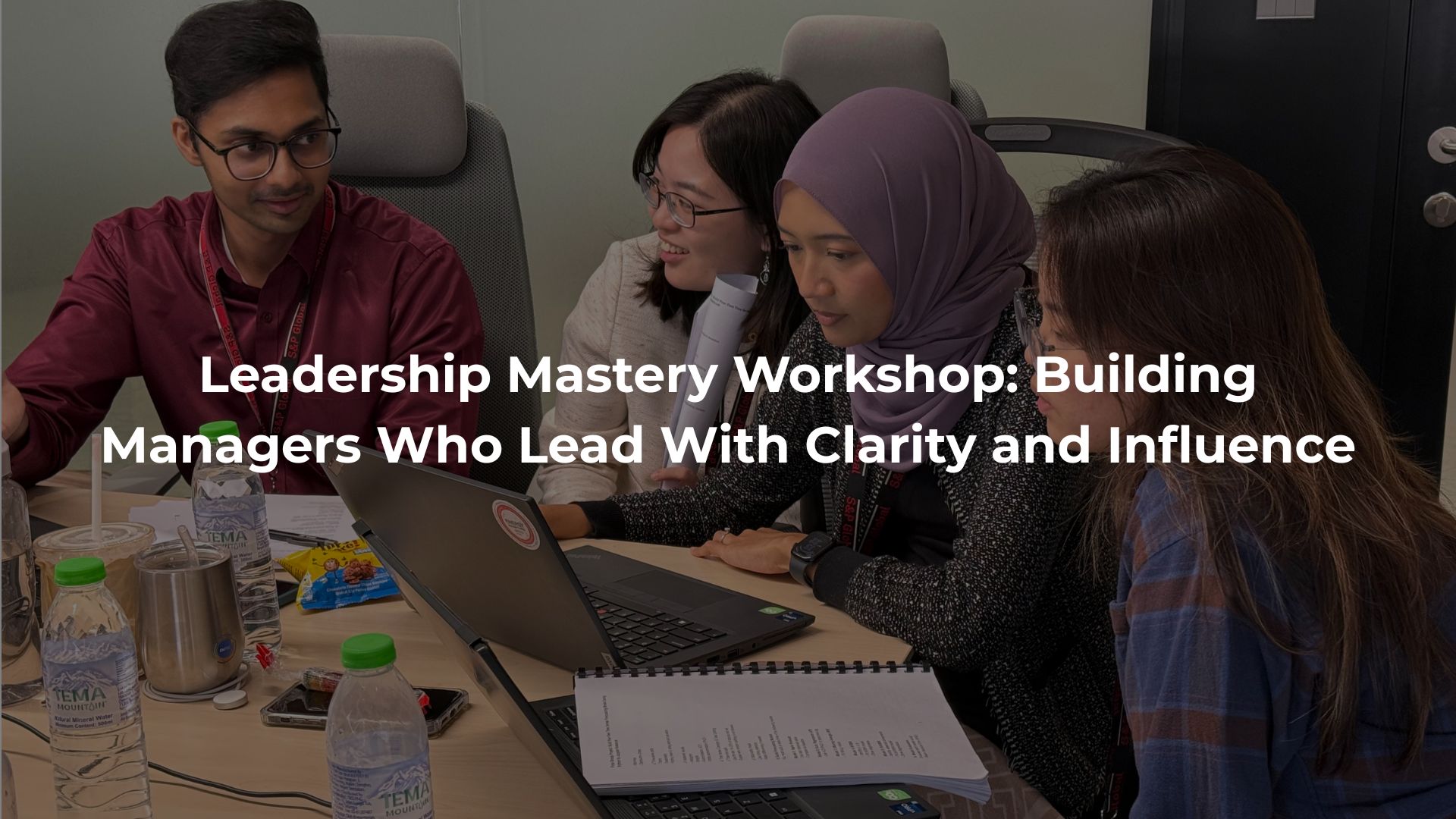
Search "leadership training Malaysia" and most of what surfaces is a compliance checklist: course duration, HRD Corp eligibility, which scheme it falls under. Useful information, but it answers the wrong question. The real question an HR lead is usually sitting on is narrower and harder: how do we get a newly-promoted manager to actually lead the people who used to be their peers?
Most companies hiring an external provider for leadership development are, in effect, buying a standardized curriculum built for no company in particular. That's the quiet trade-off behind most leadership training: consistency across cohorts, at the cost of relevance to any one of them.
Vision Building's Leadership Mastery Workshop tagged "Lead with Clarity. Influence with Purpose" is built to answer that question directly. Rather than teaching a generic competency framework, it ties every leadership behaviour back to the company's own stated vision and values, so managers leave with language and instincts that match how their organization already describes itself, not a borrowed model from a textbook.
That distinction matters because the alternative trained managers who aren't aligned to how their company actually operates is one of the most common complaints HR teams have after a generic leadership course.
The workshop moves through self-leadership before people-leadership the assumption being that a manager who hasn't examined their own decision-making patterns will struggle to coach anyone else's. That opening module tends to surface patterns managers hadn't named before: a tendency to over-explain decisions to avoid pushback, or a habit of solving a direct report's problem directly instead of coaching them through it.
From there it builds into coaching mastery for developing direct reports, emotional intelligence under real workplace pressure (not classroom hypotheticals), and strategic decision-making paired with resilience training for the discomfort that comes with unpopular calls. The coaching mastery module in particular focuses on the difference between managing a task and developing a person a distinction many first-time managers haven't had named for them before, even after months in the role.
Delivery leans on role-play, case studies, real-world simulations, and executive lab applications rather than lecture-style modules, which is what allows the same core curriculum to flex across a first-time supervisor and a team head with a much wider scope of responsibility. Role-play scenarios are built to mirror situations the specific cohort is likely to face, rather than generic management-theory examples.
Three gaps show up repeatedly among Malaysian corporate cohorts, and the workshop is structured to name each one directly rather than leave it implicit. The first is authority hesitancy a new manager who technically has the title but still defers to the room out of habit. The second is feedback avoidance, where a manager will tolerate underperformance for months rather than have an uncomfortable conversation early. The third is strategic drift, where a manager stays excellent at day-to-day execution but never develops the decision-making range needed for the next level of responsibility.
Each of these maps to a specific module: authority hesitancy is addressed directly in the self-leadership and coaching mastery modules, feedback avoidance is worked through in emotional-intelligence role-play, and strategic drift is the focus of the resilience and strategic decision-making modules in the 3-day format.
Format depends on seniority and how much ground the cohort needs to cover:
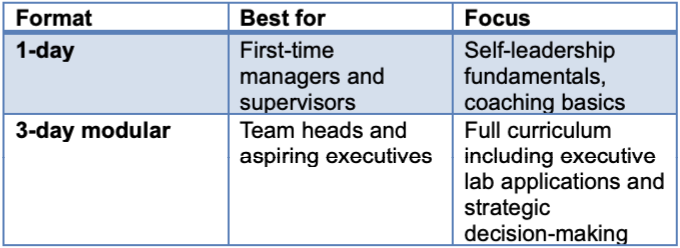
Both formats include role-play and case-study work, with the 3-day format adding depth in strategic decision-making and resilience training for leaders carrying a wider scope of responsibility.
Most leadership training in the Malaysian market is built around a standardized competency model the same modules regardless of which company is buying them. The gap that leaves is a familiar one to any HR lead who's run a post-training survey: managers can recite the framework, but it doesn't sound like how their own company actually talks about leadership.
The Leadership Mastery Workshop closes that gap by building on Vision Building's Vision-Instilled Methodology the same thread that runs through its team building programmes. Leadership behaviours are framed in terms of the company's own vision and values, so what managers learn in the workshop is immediately recognizable in how the business already operates, rather than a separate vocabulary they have to translate back into daily practice.
One of the most common and most under-addressed leadership scenarios is the first-time manager who has just inherited authority over people who were, a week earlier, colleagues at the same level. Competency checklists rarely name this problem directly. The workshop does, using role-play scenarios built specifically around authority-without-title situations, paired with the coaching mastery module and resilience training for the discomfort of making a call that a former peer won't like.
In practice, this transition fails quietly more often than it fails loudly a new manager doesn't usually lose the room in one dramatic moment, but through a slow accumulation of decisions avoided, feedback withheld, and deference to former peers that never gets corrected. The workshop's role-play scenarios are deliberately built around this slow-failure pattern rather than a single dramatic confrontation, because that's what the transition actually looks like on the ground.
The Leadership Mastery Workshop is 100% HRD Corp claimable, consistent with Vision Building's other corporate training programmes. It also works well as one option inside a broader corporate training programme comparison for companies weighing leadership development against communication, AI training, or time management priorities rather than a one-off purchase, it's designed to pair with organizational development coaching for change that compounds past the workshop itself.
A recurring complaint about leadership training generally is that it's delivered as a lecture on theory, then evaluated by a multiple-choice quiz that has little bearing on how anyone actually behaves back at their desk. The Leadership Mastery Workshop is deliberately structured to avoid that pattern: facilitators run each module as a working session, with participants applying the concept to a real situation from their own team before moving to the next module, rather than absorbing a full day of theory before ever practising it.
This also means the workshop adapts in real time to what a specific cohort is struggling with. If the role-play reveals that authority hesitancy is the dominant issue in the room, facilitators can weight the remaining time toward that scenario rather than moving through a fixed agenda regardless of what the group actually needs.
Not every group of new managers is ready for the same intensity of programme on day one. A cohort still adjusting to the basic mechanics of the role approving leave, running a first performance review, sitting in their first budget meeting often gets more value from the 1-day format focused on self-leadership and coaching fundamentals, saving the fuller strategic decision-making and resilience modules for a follow-up session once those basics feel routine.
A cohort that's further along, already comfortable with the operational mechanics but still struggling with authority and direction, is usually ready for the full 3-day modular format from the outset. Getting this sequencing right avoids the common failure mode of overloading a brand-new manager with strategic frameworks before they've stabilized the day-to-day fundamentals of the role.
Leadership training is notoriously hard to measure with a single number, but a few signals tend to show up reliably within the first month for companies that run this workshop. The clearest is a shift in language managers start using the same vocabulary for describing decisions and coaching moments, which HR can often hear directly in one-on-ones or team meetings without needing a formal survey.
A second, slower signal is a reduction in escalations that reach senior management unnecessarily as newly-confident managers start resolving decisions at their own level rather than pushing them upward out of hesitation. Companies that want a more formal measure typically pair the workshop with a short pulse survey to direct reports before and after, asking specifically about clarity of direction rather than general satisfaction, since clarity is the dimension the workshop is built to move.
The 1-day format covers self-leadership fundamentals and coaching basics for first-time managers and supervisors. The 3-day modular format adds strategic decision-making, resilience training, and executive lab applications for team heads and aspiring executives.
No. It's designed to flex across seniority levels from first-time managers and supervisors in the 1-day format to team heads and aspiring executives in the 3-day modular format.
Standard courses teach a generic competency model. This workshop ties every leadership behaviour back to the company's own stated vision and values, using Vision Building's Vision-Instilled Methodology, so what managers learn matches how their organization already operates.
Yes, it is 100% HRD Corp claimable, in line with Vision Building's other corporate training programmes.
Give your managers a leadership model that actually matches your company's vision. Get started with a proposal for the Leadership Mastery Workshop.