Team building in Malaysia typically costs RM100 to RM800 per person depending on format, duration, and venue — a half-day indoor session sits at the lower end, while a 2D1N resort retreat sits at the top. But for HRD Corp registered companies, that sticker price isn't the number that matters for budgeting. The number that matters is the effective cost after HRD Corp claim reimbursement, which can bring the employer's actual out-of-pocket cost close to zero depending on the claim scheme and remaining levy balance.
Most pricing guides for team building in Malaysia stop at the gross number. This guide goes one step further and works through the actual claim math, because for a company that pays into the HRD Corp levy, the invoice total and the real cost are two very different figures.
Before claims, gross pricing for common team building formats in Malaysia falls into roughly these ranges:
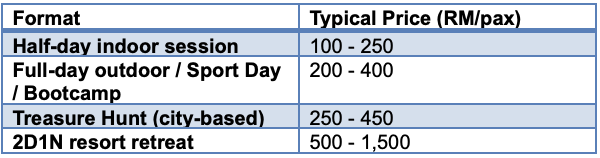
Larger groups typically secure better per-person rates, and pricing varies further based on venue, season, and whether the programme includes meals or accommodation. See the full Team Building Programmes range for what's included at each tier.
This is where the real budgeting picture changes. Under the SBL-Khas scheme, HRD Corp pays the training provider directly from the employer's levy balance — the company doesn't pay upfront and then wait for reimbursement, which means the effective employer cost can approach zero if the levy balance fully covers the invoice. Under the SBL scheme, the employer pays first and claims the amount back afterward, which still recovers the cost but affects short-term cash flow differently.
There's a second layer of claimable value that pricing guides rarely mention: distance-based allowances. For local training where the venue is at least 100km from the company's registered premises, employers can claim up to RM500 per employee per day; if the distance is shorter, the claimable allowance drops to RM250 per employee per day. For companies choosing an out-of-Klang-Valley venue anyway, this allowance meaningfully offsets travel and accommodation costs on top of the base programme claim. For the full step-by-step claim process, see the dedicated HRD Corp Claimable Team Building guide.
A concrete example makes the gap between gross and real cost clearer. A 50-person Sport Day at RM300 per person comes to a gross cost of RM15,000. If the company's HRD Corp levy balance is sufficient and the programme is booked under SBL-Khas, the employer's actual outlay approaches RM0 — HRD Corp pays the provider directly. If the levy balance only partially covers the invoice, the company tops up only the shortfall, not the full RM15,000.
If the venue is more than 100km from the company's registered address, the distance-based allowance adds further claimable value on top of the base programme cost — meaningful for companies willing to travel outside the Klang Valley for a change of scenery.
A second worked example illustrates the SBL scheme instead: the same RM15,000 Sport Day, but with the employer paying the invoice upfront and submitting a claim afterward. The company's cash flow shows the full RM15,000 leaving the account initially, with the eligible portion returning as a reimbursement once HRD Corp processes the claim — the same eventual cost recovery as SBL-Khas, just on a different timeline.
Group size is the biggest lever on per-person pricing — larger groups consistently secure better rates. Venue distance cuts both ways: it affects logistics cost directly, but it also affects the claimable allowance amount, so a further venue isn't automatically a more expensive one once claims are factored in. Season matters for outdoor formats specifically — Malaysia's wet season adds a contingency consideration for Sport Day or Bootcamp programmes that don't have an indoor-adaptable backup plan.
Add-ons like branded merchandise, professional photography, or custom themes sit outside the base programme cost and outside most HRD Corp claim categories, so these should be budgeted separately from the claimable programme fee. Vision Building's Corporate Events & Employer Branding service can quote these as clearly separated line items so the claimable and non-claimable portions of a proposal are easy to distinguish.
Start by checking the company's remaining HRD Corp levy balance before setting a budget number — this determines how much of the gross cost is realistically recoverable this cycle. Confirm SBL vs SBL-Khas eligibility with the provider upfront, since this affects both the claim process and the company's short-term cash flow. Because claims must be submitted on e-TRiS before the training date, book with enough lead time to complete the paperwork rather than finalizing a programme days before the intended date.
When requesting a proposal, ask for gross cost and expected claimable amount to be shown as separate figures — this is the only way to budget against the real number rather than the invoice total. Get started with a proposal that breaks this down clearly from the outset.
The most common mistake is budgeting against the gross quoted price without checking the levy balance first — a company with a healthy, unused levy balance might be planning around a number three or four times larger than what will actually leave the bank account. The reverse mistake also happens: companies assume full claim coverage without confirming it, then get caught short when the levy balance turns out to be lower than expected because it was already partially used elsewhere in the year.
A second common mistake is treating add-ons — branded merchandise, custom staging, professional photography — as part of the claimable programme cost when they typically sit outside HRD Corp's claim categories. Budgeting these as a separate, non-claimable line item from the outset avoids an unpleasant surprise when the claim comes back lower than the full invoice.
Not every dollar spent on team building needs to be claimable to be worth it. A company that wants a themed annual dinner with custom decor, or a treasure hunt across multiple Malaysian cities as part of a larger retreat, may reasonably choose to spend beyond what HRD Corp will reimburse because the non-claimable elements — the specific venue, the specific theme, the specific location — are what make the event memorable. The key is making that trade-off deliberately, with the claimable and non-claimable portions clearly separated in the budget, rather than discovering the gap after the invoice arrives.
Before requesting a formal proposal, most companies can get a rough estimate of their real cost with three numbers: the gross programme price per person multiplied by group size, the company's remaining HRD Corp levy balance for the year, and an honest estimate of any non-claimable add-ons. Subtracting the levy balance (up to the gross programme cost) from the gross figure, then adding back the non-claimable add-ons, gives a workable estimate of the real out-of-pocket number to bring to a budget conversation — well before a formal proposal is even requested.
Comparing two providers purely on gross quoted price misses the variable that often matters most: whether the provider actively helps manage the HRD Corp claim process or leaves the client's HR team to handle documentation and submission alone. A slightly higher quoted price from a provider that manages claims proactively can easily work out cheaper in real terms than a lower quote from a provider that leaves claim administration entirely to the client, especially if that gap results in a rejected claim like the one described in this case study.
When comparing quotes, it's worth asking each provider directly how they support the claim process — whether they prepare documentation alongside programme planning, whether they've had claims rejected for past clients, and whether they can share a realistic estimate of claimable value rather than just the gross programme fee.
Gross pricing typically ranges from RM100-250/pax for a half-day indoor session up to RM500-1,500/pax for a 2D1N resort retreat, depending on format, group size, and venue.
Potentially, yes — under the SBL-Khas scheme, HRD Corp pays the provider directly from the employer's levy balance, which can bring the employer's out-of-pocket cost close to zero if the levy balance covers the full invoice.
SBL-Khas is a direct-payment scheme where HRD Corp pays the provider directly from the levy balance. SBL is a reimbursement scheme where the employer pays first and claims the cost back afterward.
Yes. For venues at least 100km from the company's registered premises, employers can claim up to RM500 per employee per day in allowances; closer venues have a lower claimable allowance of RM250 per employee per day.
Want a proposal that shows your real cost after HRD Corp claims, not just the invoice total? Get started. For the naming and scheme questions behind these numbers, see the HRD Corp vs HRDF FAQ, and for what can go wrong with a claim, read this case study.