Most corporate training decisions in Malaysia start from the wrong place: which programme is popular this quarter, or which one still has budget attached to it before the HRD Corp levy resets. The better starting point is the specific symptom showing up on the floor because communication breakdowns, authority gaps, unmanaged AI adoption, and calendar chaos are four different problems that call for four different programmes.
Vision Building runs four core corporate training programmes: Effective Communication Workshop, Leadership Mastery Workshop, the A.I. Training Programme, and a Time Management Workshop. Here's how to match the actual problem to the right one, before committing a training budget.
Before comparing programmes, name the symptom precisely. Is it communication breaking down across departments or with clients? Is it a newly-promoted manager who doesn't yet know how to lead people rather than just complete tasks? Is AI already touching workflows without any shared framework for how decisions should change? Or are teams missing deadlines despite workloads that look reasonable on paper? Each of those maps to a different one of Vision Building's four programmes.
This matters more than it sounds, because the four symptoms often present with overlapping surface signs. A team that's missing deadlines might genuinely have a time-management problem, or the deadlines might be slipping because a manager isn't clearly prioritizing what matters which is a leadership problem wearing a calendar costume. Getting the diagnosis right before booking a programme is the single highest-leverage decision in this whole process.
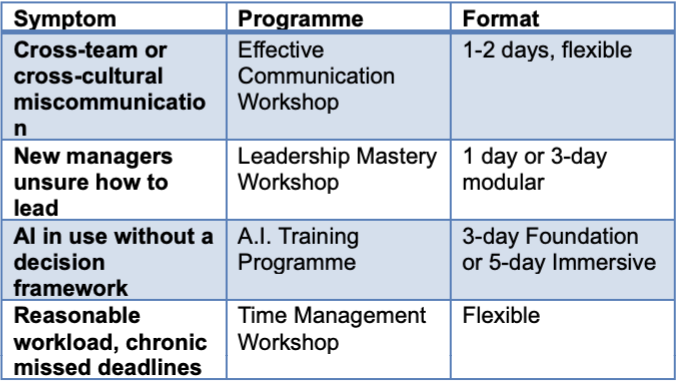
Tagged "Speak Human. Think A.I.," this is the right starting point when the friction is cross-cultural or cross-department miscommunication. It runs as a flexible 1-2 day programme and includes AI-enhanced messaging models built for hybrid teams useful for companies where some communication now happens through AI-assisted channels as well as face to face.
A telling sign this is the right first purchase: the same information gets interpreted differently by different departments, or messages that feel clear when sent land as ambiguous or even conflicting once they reach the receiving team. That's a communication-clarity problem, not a leadership or time-management one, and it tends to compound quietly until it shows up as a missed handoff or a client complaint.
When the issue is a newly-promoted manager unsure how to lead former peers, or unclear decision ownership further up the chain, the Leadership Mastery Workshop is the better fit. It ties leadership behaviour back to the company's own vision rather than a generic competency list, and runs as a 1-day or 3-day modular programme depending on seniority.
If AI is already in daily use across the team but nobody has agreed on how decisions should change because of it, the A.I. Training Programme addresses that gap directly, using the 3A+P Framework rather than tool tutorials. It's offered as a 3-day Foundation or 5-day Immersive format.
Sometimes the real issue isn't communication, leadership, or AI at all it's a team with a reasonable workload that still can't hit deadlines because prioritization systems haven't kept pace with how much is on everyone's plate. The Time Management Workshop addresses the prioritization layer directly, and is often the fastest win to buy first when leadership or AI training feels premature for where a team currently is.
It's also a useful diagnostic in itself: if a team goes through the workshop and deadlines still slip afterward, that's often a signal the real issue was never the calendar it was unclear leadership direction about what actually matters, which points back toward the Leadership Mastery Workshop instead.
This programme tends to work best as a company-wide or department-wide rollout rather than a leadership-only cohort, since prioritization habits are something every individual contributor needs, not just managers. That's a useful distinction when budgeting: unlike the Leadership Mastery Workshop, which is usually run for a targeted management cohort, the Time Management Workshop delivers more value spread across a wider group.
Few companies need all four programmes at once, and running them back-to-back tends to dilute each one's impact. A more effective approach is sequencing: a company dealing with basic prioritization chaos might start with the Time Management Workshop in the first quarter, move newly-promoted managers through the Leadership Mastery Workshop once workload pressure has eased, and reserve the A.I. Training Programme for when leadership is ready to make it a strategic priority rather than a reactive purchase.
This sequencing also has a practical benefit for HRD Corp levy planning spreading claimable programmes across the training calendar rather than in a single quarter makes it easier to plan cash flow around the SBL or SBL-Khas reimbursement timelines, since claims are typically processed per programme rather than as a lump sum.
It's worth repeating the core distinction here since it's easy to conflate with generic AI tool training when comparing programmes at a glance: the A.I. Training Programme isn't teaching staff to use a specific AI tool better. It's giving leadership a shared framework for deciding where AI-assisted decisions need a human check and where they don't a governance question, not a software-skills question. Companies comparing this against a cheaper, tool-specific AI course should weigh that distinction carefully, since the two are solving different problems even though both get marketed under "AI training."
A quick reference for matching symptom to programme:
All four programmes are HRD Corp claimable, and none of them need to be bought in isolation many companies sequence two or three across a training calendar, with organizational development coaching supporting the follow-through on whichever programme is chosen.
This is worth naming plainly, since it's the actual cost of a misdiagnosis. A leadership-training purchase aimed at a communication problem will still produce a reasonably well-reviewed workshop the facilitators are good, the material is sound but the underlying friction the company was actually trying to solve will still be there a month later. That gap between "the training went well" and "the problem is solved" is usually where HR ends up having an uncomfortable conversation about training ROI with finance or the board.
The fix isn't more training, it's better diagnosis before the first purchase which is exactly what the symptom-first approach in this guide is built to support.
Companies that aren't sure which symptom is the real one don't need to self-diagnose alone. A short scoping conversation before any programme is booked typically surfaces which of the four problems is actually driving the request often a company comes in asking for leadership training and, after a scoping conversation, realizes the more urgent gap is communication or time management instead.
This scoping step matters because buying the wrong programme first doesn't just waste budget it can also make HR's next training request a harder sell internally if the previous one didn't visibly move the needle. Starting with an accurate read on the actual symptom protects both the training budget and HR's credibility in proposing the next one.
A few combinations come up often enough to be worth naming directly. Companies going through a fast promotion cycle tend to pair the Leadership Mastery Workshop with the Time Management Workshop, since new managers are usually navigating both an authority gap and a sudden jump in workload simultaneously. Companies rolling out AI tools company-wide tend to pair the A.I. Training Programme for leadership with the Effective Communication Workshop for the wider team, so the messaging around the AI rollout stays consistent from the top down.
Less common but increasingly requested is running all four across a single year as a structured leadership-development calendar — typically Time Management or Communication in the first half of the year to address immediate friction, followed by Leadership Mastery and A.I. Training in the second half once the team has more capacity to focus on longer-range capability building rather than firefighting.
Start from the specific symptom on the floor rather than the most popular programme name — communication friction, unclear leadership authority, ungoverned AI use, or missed deadlines each point to a different one of the four programmes.
Yes. Many companies sequence two or three programmes across a training calendar rather than buying all four at once, pairing them with organizational development coaching for follow-through.
Yes, the Effective Communication Workshop, Leadership Mastery Workshop, A.I. Training Programme, and Time Management Workshop are all HRD Corp claimable.
If the friction is about information not landing clearly between people or departments, it's a communication problem. If it's about a manager unsure how to direct, coach, or make calls that affect a team, it's a leadership problem — the two often look similar from the outside but need different programmes.
Not sure which programme fits your team? Get started with a proposal and Vision Building will help match the training to the actual problem.