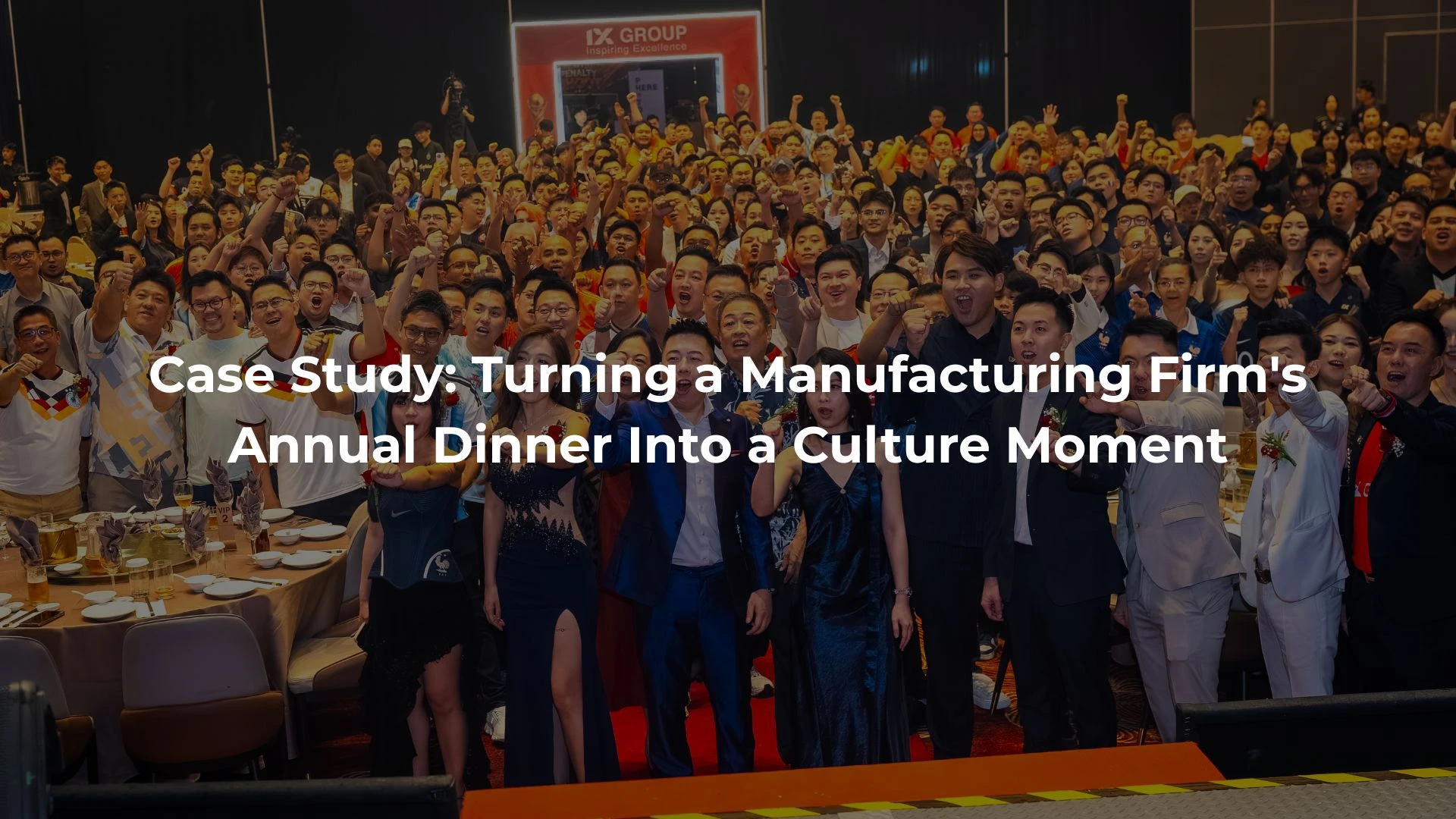
A 320-person manufacturing firm in Shah Alam had run essentially the same annual dinner format for six years: a buffet, a round of awards, a live band. On paper it looked fine. In practice, senior management attendance had been quietly slipping year over year, and shift workers who made up a large share of the workforce rarely ended up at the same tables as office staff, even on the one night the whole company gathered in one room.
The brief wasn't to spend more. It was to make the evening mean something again to turn the one night a year the entire company shares a room into an actual culture moment, not a repeated formality people had started quietly opting out of.
This is a common pattern among manufacturing and operations companies with a mixed shift-and-office workforce: the annual dinner is often the single night of the year when the full company is physically together, which makes it a disproportionately important culture touchpoint even though it's budgeted and planned like a routine event.
Beyond declining senior attendance, the deeper issue was that the dinner had never had a stated objective beyond "have a dinner." Without one, the format had calcified into the same buffet-awards-band structure year after year, and the seating plan had never been designed to do anything beyond seat people shift and office staff sat where they always sat, with whoever they always sat with.
HR had noticed the attendance slippage for two years running before deciding to act on it, initially assuming the fix was a bigger budget a better venue, a more expensive band, a livelier programme. The redesign process started by testing that assumption directly, and it didn't hold up: staff exit interviews and informal feedback pointed to the evening feeling repetitive and disconnected from anything that had happened at the company that year, not to the quality of the food or entertainment.
The redesign started with objective-setting before any theme conversation happened deciding specifically what the evening was meant to achieve that year, rather than jumping straight to decor. That conversation surfaced a specific, nameable goal: closing the gap between shift-floor staff and office-based staff, who by the company's own admission barely interacted outside of the occasional operational escalation.
From that objective, a theme was chosen with seating design built in specifically to mix shift and office staff at the same tables, something the previous six years of dinners had never attempted. Table assignments were built around mixed project teams rather than department or seniority, so people who worked adjacent to each other on the floor but rarely spoke directly ended up seated together for the evening.
Recognition moments were rebuilt around the year's actual safety and production milestones, placed as the emotional centrepiece of the programme rather than a quick awards segment squeezed in before the band started. Specific shift supervisors and production leads who had driven measurable safety improvements over the year were named directly, rather than the recognition segment defaulting to generic "employee of the year" categories disconnected from what had actually happened on the floor that year. Vision Building's Corporate Events & Employer Branding service coordinated venue, decoration, and entertainment end to end around that redesigned flow.
Senior management attendance returned to full turnout for the first time in several years. Shift and office staff sat together at mixed tables for the first time the company could recall, and the milestone recognition segment rebuilt around real production and safety achievements became the part of the evening people talked about afterward, rather than the buffet or the band. The company asked for the same objective-first approach to be carried into the following year's planning, rather than reverting to the old format.
HR's own post-event feedback, gathered informally in the days after, flagged the mixed seating as the most-mentioned detail several long-serving shift staff noted it was the first time in years they'd had a real conversation with someone from the office side of the business. That kind of specific, repeatable feedback is what gave the company confidence to keep the redesigned format rather than treating it as a one-year experiment.
The reusable lesson isn't specific to manufacturing: set the event's objective before choosing a theme, use seating and theme design deliberately to mix groups that don't normally interact, and build recognition into the evening's actual programme flow rather than treating it as an interruption to dinner. For a full breakdown of theme options and decoration tiers to apply this approach, see the Annual Dinner Theme Ideas & Decoration Guide, and for the broader case on why this matters, why an annual dinner matters to company culture.
It's also worth naming what this case study doesn't show: the redesign didn't require a bigger budget than the previous six years of dinners, and it didn't require abandoning the buffet-and-band elements the company was comfortable with. The core change was sequencing — deciding the objective and the seating strategy before the decor conversation started, rather than defaulting straight to venue and catering choices as the first planning step.
A mid-sized manufacturing firm with a mixed shift and office workforce — a common structure among Vision Building's manufacturing and operations clients in the Klang Valley.
By setting a clear objective for the evening before choosing a theme, and rebuilding the recognition segment around real milestones rather than a routine awards format — giving senior leaders a substantive reason to prioritize attending.
Yes. The core method — objective before theme, deliberate seating design, milestone-based recognition — scales down to smaller teams as easily as it scales up to 300+ person events.
Yes. The Corporate Events & Employer Branding service covers objective-setting and theme design through to venue, decoration, and entertainment coordination end to end.
Want your next annual dinner to be a culture moment, not just a formality? See more stories or get started with a proposal.