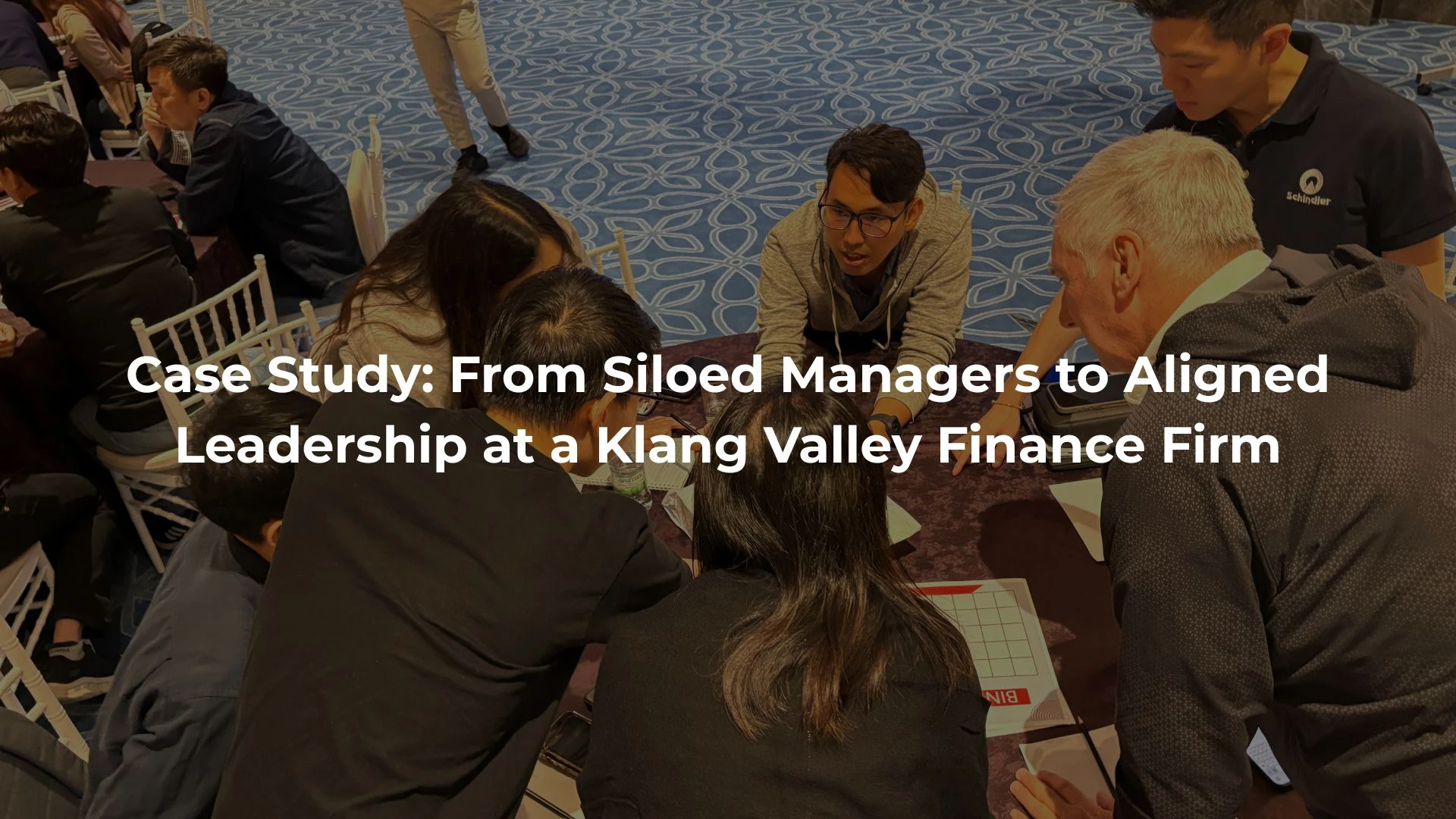
A finance firm in the Klang Valley had promoted six mid-level staff into management roles within an eighteen-month window a fast pace of growth that looked like a success story on paper. In practice, every one of the six was still leading the way they had operated as an individual contributor: making decisions alone, hesitating to direct former peers, and applying the same caution that had made them excellent analysts in ways that were now slowing down an entire team.
The company hadn't under-invested in the promotions. It had under-invested in the transition each of those six people actually needed support to make.
This pattern is especially common in finance and professional-services firms, where the individual-contributor skills that earn a promotion precision, caution, deep subject-matter expertise are not automatically the skills a manager needs to direct a team, set priorities, or make a call under ambiguity. The gap between the two rarely shows up in a performance review; it shows up in the day-to-day friction of a team that doesn't quite know who's steering.
By the time the company reached out, the six managers had been in their roles long enough that the usual advice "give it time, they'll grow into it" had already been tried and clearly wasn't enough on its own.
Beyond the individual-contributor habits carrying over, several of the six were now managing people who had been their peers a matter of months earlier creating a specific hesitancy around exercising authority that showed up as delayed decisions and avoided conversations. With no shared leadership vocabulary across the cohort, each manager was also improvising their own approach, meaning direct reports across departments were getting inconsistent direction depending on which of the six they reported to.
The company's HR lead had noticed the pattern in exit interviews from a few departing junior staff, who cited unclear direction and inconsistent expectations from their managers as a contributing factor a signal that the leadership gap wasn't just an internal inconvenience, but was starting to show up in retention.
The company ran the full cohort of six through the 3-day modular Leadership Mastery Workshop together, rather than sending them individually over time. Running the workshop as an intact cohort was a deliberate choice the company had initially considered staggering the six through public workshops as schedules allowed, but chose the group format specifically so the shared vocabulary being built would take root at the same pace across all six rather than arriving unevenly.
Role-play scenarios were built specifically around the peer-to-manager transition the exact situation several of the six were navigating paired with the coaching mastery module for developing direct reports and resilience training for the discomfort of making calls a former peer won't like. Several scenarios were adapted directly from situations the six had described during pre-workshop conversations, rather than generic hypotheticals, which made the practice sessions feel immediately relevant rather than abstract.
Throughout the programme, leadership behaviours were tied back to the finance firm's own stated values rather than a generic competency framework, giving the cohort a shared vocabulary that matched how the company already talked about itself. This mattered particularly in a finance environment, where the existing culture already prized precision and caution the workshop had to reframe those same traits as leadership assets when applied to team direction, rather than asking the cohort to abandon the instincts that had made them strong individual contributors in the first place.
Within weeks, all six managers reported greater confidence making calls they would previously have delayed or avoided, and perhaps more importantly for a group promoted together a shared leadership vocabulary emerged that hadn't existed before the workshop. Direct reports across the six teams independently noted clearer and more consistent direction from their managers. The company has since extended the same cohort-based approach to its next round of internal promotions, paired with the broader Corporate Training suite as those managers' needs evolve.
One specific, recurring piece of feedback from the cohort was around the peer-to-manager role-play scenarios in particular several managers noted it was the first time anyone had explicitly acknowledged how uncomfortable that specific transition is, rather than assuming it would resolve itself once someone had held the title for long enough.
The clearest transferable lesson is training new managers as a cohort rather than individually a shared vocabulary is one of the biggest unlocks a leadership programme can create, and it's only available when a group goes through it together. The second is naming the peer-to-manager transition directly in the training design, rather than assuming new managers will work it out on their own. For companies weighing this against other training priorities, the Corporate Training Programme Comparison breaks down when leadership training is the right first move versus communication, AI training, or time management.
A third, less obvious lesson from this engagement: the exit-interview signal was what actually triggered the company to act, which is a reminder that leadership gaps are often visible in retention data well before they show up in a formal performance or engagement survey. Companies sitting on unexplained junior-level attrition may want to look at manager tenure and promotion timing as a possible contributing factor before assuming the cause lies elsewhere.
A mid-sized finance firm in the Klang Valley that had promoted several individual contributors into management roles in a short window — a common pattern among Vision Building's professional-services clients.
Training a cohort together builds a shared leadership vocabulary across the group, which is difficult to achieve when managers go through training separately at different times.
The company reported managers showing greater confidence in decision-making within weeks of completing the 3-day modular workshop.
No. The peer-to-manager transition and the need for a shared leadership vocabulary are common across industries — this case study happens to be from finance, but the same dynamics show up in manufacturing, tech, and services companies.
Have a cohort of new managers who need more than a title change to lead well? See more stories or get started with a proposal for the Leadership Mastery Workshop.