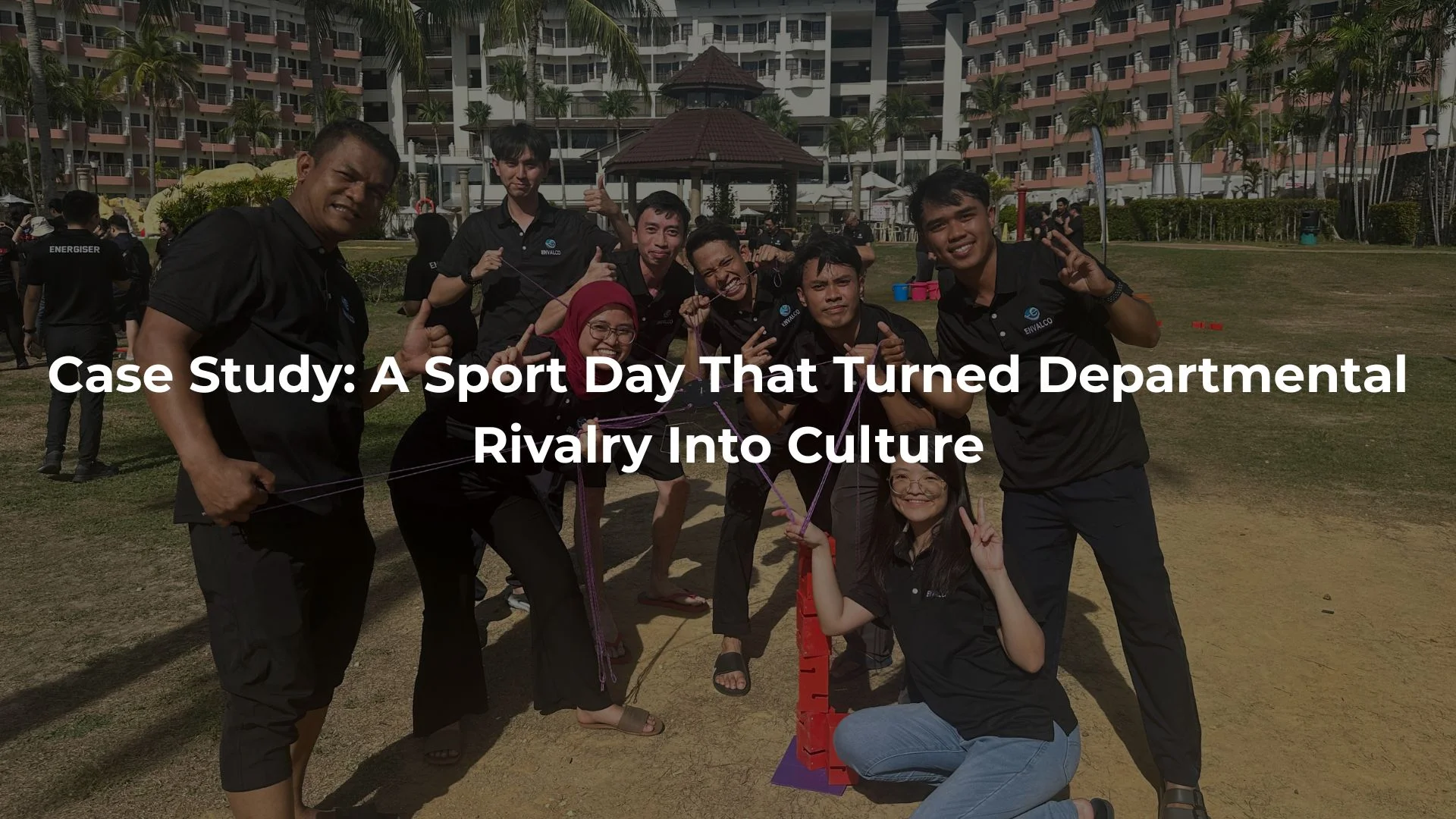
A logistics company in Shah Alam had two departments — warehouse operations and customer service — that barely interacted outside of complaint escalations. The friction wasn't dramatic; it showed up quietly, as slow email replies and a general assumption on each side that the other didn't understand the pressure they were under. A Sport Day, deliberately structured to mix the two teams, changed that in a single afternoon.
The company had tried an indoor communication workshop the previous year, aimed at improving cross-department collaboration. It reached the office-based customer service team well but barely registered with warehouse staff, who found the format disconnected from their day-to-day physical work. The brief for this engagement was specific: something both teams would actually show up for and engage with, not just tolerate.
This is a common pattern among companies with a physically split workforce — a warehouse floor and an office, a factory line and a sales team, a delivery fleet and a back office. The two groups can go months without a genuine, non-transactional conversation, simply because their working days never naturally overlap.
Beyond the response-time friction, the deeper issue was structural: warehouse and office staff were physically separated for most of the working day, which made casual, organic bonding difficult even when there was no active conflict. The previous indoor workshop had inadvertently reinforced the divide rather than closing it — a seated, discussion-heavy format naturally favoured the office-based team's communication style and left warehouse staff feeling like an afterthought.
Management was also cautious about trying another team building intervention so soon after the first one had underwhelmed — there was a real risk of the whole idea of team building being written off internally as something that "doesn't work here" if a second attempt also failed to land with the warehouse team specifically.
A Sport Day was chosen specifically because its physical, competitive format doesn't favour either team's usual working style — a relay race or tug-of-war rewards effort and coordination equally, regardless of whether someone spends their day at a desk or on the warehouse floor. Team assignments were deliberately mixed so that no relay team was entirely warehouse or entirely office staff; every team had to figure out how to combine both groups' strengths to compete.
Scoring was weighted toward teamwork and mutual encouragement rather than pure athletic performance, which kept the day inclusive for staff with a wide range of fitness levels across both departments. The day closed with a facilitated debrief that explicitly connected what had just happened on the field — strangers from different departments learning to trust and support each other under time pressure — back to the daily collaboration friction the company had originally flagged.
HR specifically requested that the debrief avoid naming the original friction directly or singling out either department, since doing so risked reopening the exact tension the day was designed to ease. Facilitators instead let the team's own experience during the day do the talking, asking open questions about what had made their relay team work well rather than referencing the complaint-ticket history at all.
Warehouse and office staff who had previously only interacted through complaint tickets formed genuine working relationships through their mixed relay teams. In the weeks following the event, the company reported noticeably improved response times between the two departments — not because a policy changed, but because staff on both sides now had a face and a name attached to requests coming from the other team, rather than an anonymous department.
Staff specifically requested a repeat Sport Day the following year, and the company has since extended the deliberate team-mixing approach to other internal events beyond team building specifically, treating it as a reusable tool for breaking down departmental silos rather than a one-off event format.
One detail HR flagged as particularly telling: in the weeks after the event, staff began referencing the Sport Day teams by name when coordinating across departments — "ask the Red Team" became informal shorthand that crossed the old departmental line, a small but concrete sign that the mixed groupings had outlasted the day itself.
The transferable lesson isn't specific to logistics or warehouse-office splits: deliberate team mixing matters more than the activity chosen, and a physical, inclusive format can reach staff that an indoor, discussion-heavy workshop misses entirely. Scoring for teamwork rather than pure competition keeps the format inclusive across a wide range of fitness levels and working styles. And throughout, the programme remained HRD Corp claimable, consistent with Vision Building's other team building formats.
For companies with a similar physical divide in their own workforce — a warehouse and an office, a factory floor and a sales team — the specific activity matters less than the willingness to deliberately engineer interaction that wouldn't happen naturally. A Sport Day is one effective tool for that; the underlying principle of deliberate mixing applies well beyond it.
A mid-sized logistics company in Shah Alam with a physically split workforce — warehouse operations staff and office-based customer service staff — a common structure among Vision Building's logistics and operations clients.
The physical, competitive format didn't favour either team's usual working style, unlike the previous indoor discussion-based workshop, which had inadvertently favoured office staff and left warehouse staff feeling disconnected.
Relay teams were deliberately assembled so no team was entirely warehouse or entirely office staff, forcing every team to combine both groups' strengths to compete.
Yes. Deliberate team mixing and teamwork-weighted scoring are reusable principles that apply to any company with departments that are physically or functionally separated in daily work.
Have departments that barely interact day to day? See more stories or get started with a proposal for a Sport Day. Read the full breakdown of what a Sport Day involves in this guide, and confirm claimability in the HRD Corp vs HRDF FAQ.