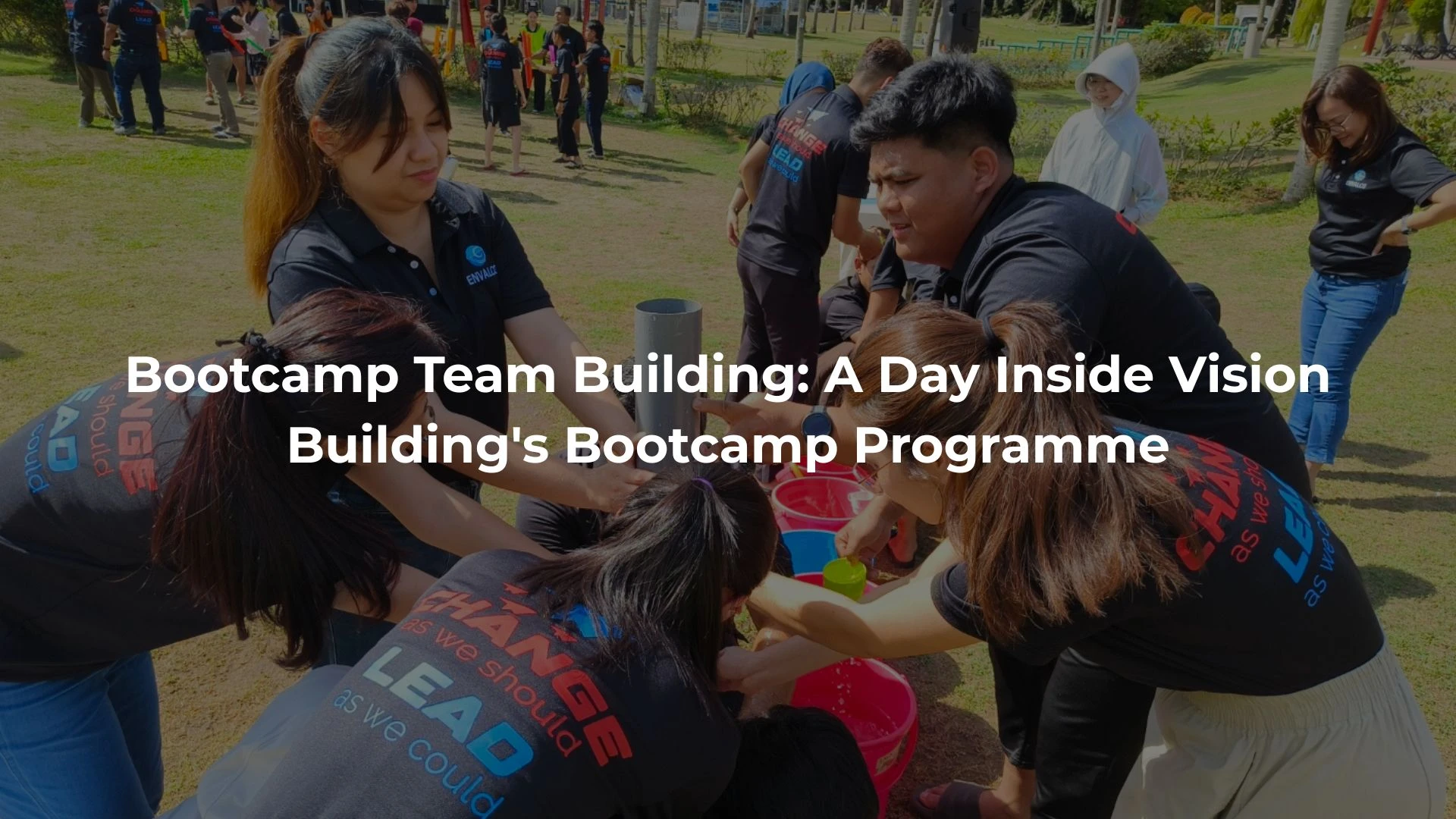
A corporate bootcamp is a structured, high-discipline team building day built around timed physical and mental challenges completed as a unit — closer to a military-style obstacle circuit than a casual sports afternoon. It's one of Vision Building's named team building programmes, built specifically for teams that have outgrown standard icebreakers and want something that genuinely tests them, together.
The distinction from a Sport Day is worth being precise about. A Sport Day is competitive and high-energy, built around games teams win or lose against each other. A Bootcamp is built around a shared circuit the whole group has to get through as a unit — the test is endurance and mutual support, not who scores the most points. Teams that choose bootcamp are usually looking for a bigger physical and mental challenge than a standard team building day offers.
This distinction shapes the entire day. Where a Sport Day rewards a team for outperforming other teams, a Bootcamp only succeeds if the whole group finishes together — a structural design choice that makes the format uniquely suited to companies trying to build genuine interdependence, not just friendly competitive spirit.
A bootcamp day runs on timed obstacle circuits completed as a unit rather than as individuals — a team only clears a station when every member has, which builds in a structural incentive for stronger participants to support weaker ones rather than race ahead. Mental challenges are woven between the physical stations, so the day isn't purely a fitness test; teams have to think clearly under physical fatigue, which mirrors real workplace pressure more closely than a standalone physical circuit would.
The whole day runs on military-inspired structure and discipline: morning briefings, timed transitions between stations, and a closing debrief, all facilitator-led from start to finish. Safety is designed in at every stage, not bolted on afterward — station difficulty, pacing, and rest breaks are all planned around the specific group's fitness profile.
A typical full-day Bootcamp Programme follows a structure like this:
Time
Activity
Morning
Briefing, safety orientation, team formation
Mid-morning
Obstacle circuit rotation (3-4 stations)
Midday
Mental-challenge round (strategy, problem-solving under time pressure)
Afternoon
Final challenge combining physical and mental elements
Late afternoon
Closing debrief and recognition
Exact timing flexes based on group size and venue, but this structure — physical, then mental, then a combined final test — is consistent across most Bootcamp Programme days.
Bootcamp carries a higher level of discipline and structure than a Sport Day, and it tests endurance and mental resilience rather than pure competition. It tends to be the format teams choose after they've already been through other team building days — a treasure hunt, a theme-based dinner, a standard sports afternoon — and want something that feels genuinely harder to get through, precisely because getting through it together is the point.
The shared outcome teams report most often isn't "that was fun," it's "we got through that together" — a specific kind of story that sticks with a team longer than a typical icebreaker exercise does.
Bootcamp works best for physically capable, motivated teams who want to be tested, not teams looking for a relaxed day out. Intensity levels are modifiable for mixed-fitness groups, and medical screening plus safety briefings are built into every programme, but companies should be honest about their team's actual fitness and appetite before booking — a team that needs rest and recovery is better served by a Destress programme, not a bootcamp circuit.
A useful gut-check before booking: has the team recently asked for "something harder" or expressed that previous team building days felt too easy or too passive? That specific feedback is usually the clearest signal that Bootcamp, rather than a gentler format, is the right fit for where the team currently is.
Bootcamp requires an outdoor venue and is weather-dependent, so scheduling around Malaysia's wet season is worth planning for in advance. Most programmes run as a full-day format, with group sizes ranging from a single department of around 20 people up to larger cross-functional cohorts. Like Vision Building's other team building programmes, Bootcamp is HRD Corp claimable under the standard programme structure.
The design detail that separates a genuinely useful bootcamp circuit from an obstacle course for its own sake is the pass condition: a team only completes a station once every member has, not once the fastest members finish. This single rule changes the entire dynamic of the day — teams that ignore their slower or less confident members finish stations more slowly than teams that actively coach and support each other through, which is exactly the behaviour the programme is designed to build.
Facilitators watch for and call out this dynamic in real time, naming moments where a team either pulled together or left someone behind, so the lesson doesn't have to wait for the closing debrief to land. By the final combined challenge of the day, most teams have visibly shifted from an individual-performance mindset to a collective one, without ever being explicitly told to.
A standard team building retreat often mixes light activities with free time and social meals. Bootcamp is deliberately more concentrated — most of the day is spent in structured, facilitator-led activity rather than unstructured social time, which is a trade-off worth being upfront about. Companies choosing bootcamp are trading some of the relaxed, social pacing of a typical retreat for a more intense, focused shared experience, and that trade-off should match what the team actually wants from the day.
Because Bootcamp is more physically demanding than most team building formats, the day after matters as much as the day itself. Vision Building typically recommends scheduling a bootcamp on a Friday or ahead of a lighter workday, giving participants time to recover rather than heading straight back into a demanding work schedule the next morning. Companies that pair the physical challenge with a same-day or next-day debrief tend to retain the day's lessons longer than those that let the experience fade without any structured follow-through.
Some companies also print or circulate photos and results from the day afterward — the leaderboard, candid shots of teams mid-obstacle — as a lightweight way of keeping the shared experience visible in the office for weeks after the actual event.
Teams move through timed physical obstacle circuits and mental challenges completed as a unit, with the day structured around discipline, briefings, and a closing debrief — modelled loosely on military-style training days.
It's designed to be more physically demanding than a typical team building day, though intensity is modifiable for mixed-fitness groups. Teams wanting a low-intensity day should choose the Destress programme instead.
Sport Day is competitive, with teams scored against each other. Bootcamp is a shared circuit the whole group completes together as a unit, testing endurance and mutual support rather than who wins.
Yes, Bootcamp is HRD Corp claimable under Vision Building's standard team building programme structure.
Ready to give your team a challenge they'll actually remember? Get started with a proposal for the Bootcamp Programme.