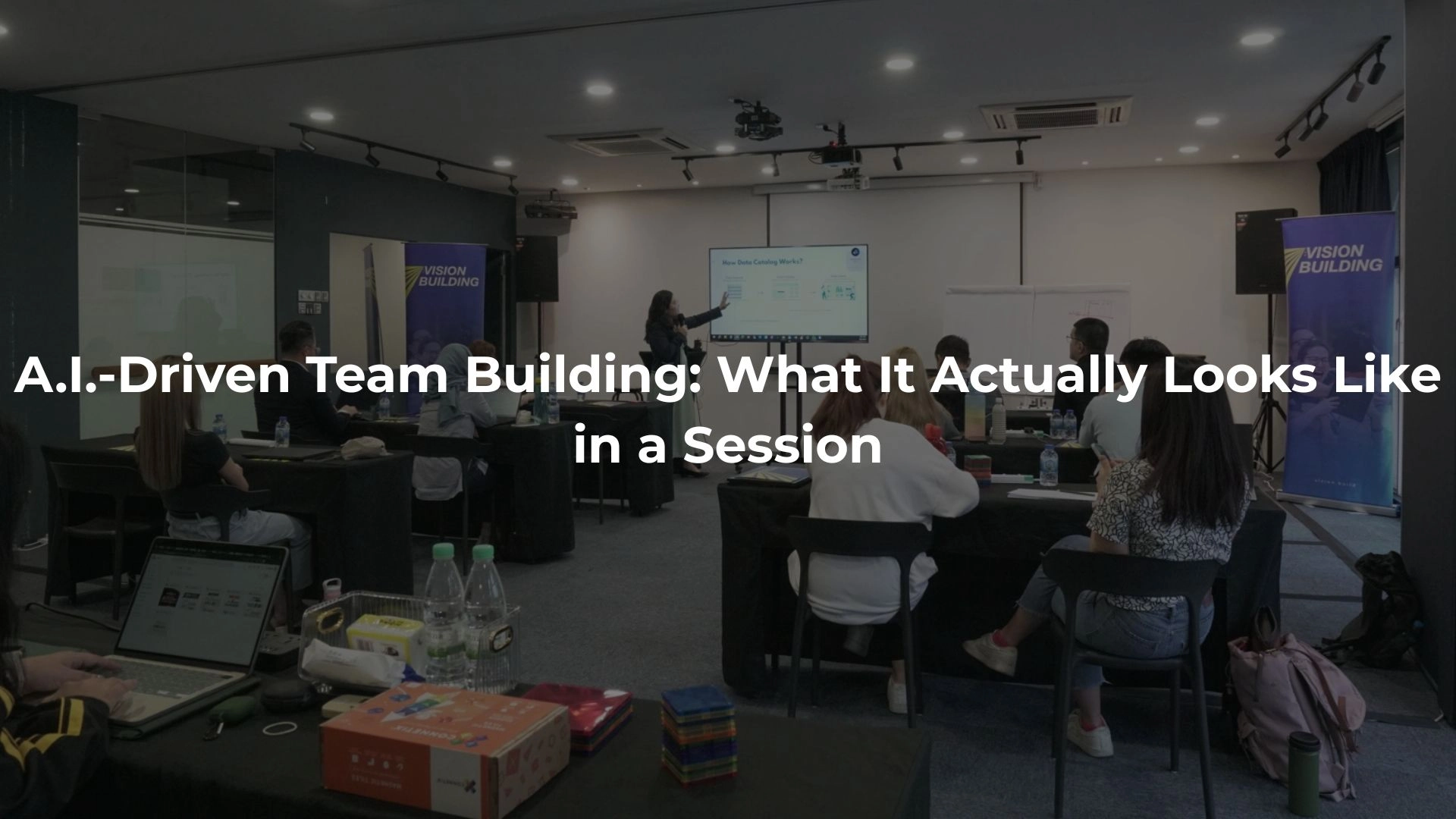
A.I.-driven team building is a team building format where AI tools are built directly into the activity's game mechanics — teams use AI to generate images, solve puzzles, or complete creative challenges together — rather than a session where the team sits and learns about AI as a topic. It's one of Vision Building's named team building programmes, distinct from a training course, designed for teams that already use AI tools in their daily work and want a team building day that reflects that.
This is worth clarifying up front because the name causes real confusion. Companies searching for "AI team building" are sometimes actually looking for AI skills training for their leadership team — that's a different Vision Building programme entirely, covered separately in the A.I. Training Programme. This article is specifically about the team building format: what a session looks like, station by station, when AI is the game mechanic rather than the subject matter.
The demand for this specific format has grown alongside how normalized AI tools have become in everyday knowledge work — for many teams, using an AI assistant is no longer a novelty but a routine part of the working day, which is exactly the shift this programme is built to reflect rather than ignore.
In practice, this means AI shows up as a collaborative tool inside the challenges themselves. A team might use an AI image generator to create a visual that another team has to guess, or use an AI chatbot as a puzzle-solving partner where the team has to figure out the right questions to ask to unlock the next clue. The AI isn't the thing being taught — it's the thing the team is playing with together.
This format sits alongside Vision Building's other named team building categories — Destress, Theme-Based, Vision-Driven, Sport Days, Treasure Hunt, and Bootcamp — as a distinct option built specifically for teams whose daily work already involves AI tools, rather than a generic activity with an AI label attached.
A typical session rotates through several AI-mechanic stations. One common format is an AI image-generation challenge, where each team is given a prompt-writing brief and has to collaboratively craft a prompt that produces a specific visual outcome, judged by the other teams. Another is an AI-assisted puzzle station, where the team uses an AI tool as a conversational partner to work through a series of clues that require increasingly specific questions to unlock.
A prompt-writing relay is another popular round: teams compete to get an AI tool to produce a target output — a joke, an image, a short story matching a brief — in the fewest attempts, which rewards clear team communication about what to try next as much as it rewards creativity.
A fourth station format some sessions include is a scenario-building challenge, where teams use an AI tool to co-write a short fictional business scenario, then present and defend their scenario's logic to the room — a lighthearted format that still exercises real collaborative reasoning under a bit of social pressure.
Every session closes with a debrief connecting the AI collaboration patterns the team just experienced to how they collaborate in real work — teams that communicated clearly about what to ask the AI for tend to also be the teams that communicate clearly about what they need from each other day to day, which is usually the most memorable part of the session.
It's worth stating plainly since the names are easy to confuse: A.I.-Driven Team Building is a team building programme that uses AI as a game mechanic to build bonding and culture. The A.I. Training Programme is a separate corporate training course built around the 3A+P Framework, aimed at leadership teams making structural decisions about AI adoption. One is about play and connection; the other is about decision-making and organizational design. Some companies run both in the same year — the training for leadership, the team building session for the wider team — but they serve different objectives and shouldn't be treated as interchangeable.
A simple way to keep them straight when briefing internal stakeholders: if the outcome you want is "our team had a great time bonding using tools they already love," that's A.I.-Driven Team Building. If the outcome you want is "our leaders know how to make better decisions now that AI is part of the picture," that's the A.I. Training Programme.
This format works best for tech, digital, and knowledge-work teams already using AI tools daily — the session feels like a natural extension of how they already work, rather than a novelty. Younger workforces comfortable experimenting with new tools tend to get the most out of the format, since a chunk of the value comes from playful, low-stakes experimentation.
It's a strong fit for companies specifically wanting team building that reflects how their team actually operates day to day. It's a weaker fit for teams specifically wanting a fully offline, tech-free reset — for that objective, a Destress programme or an outdoor Treasure Hunt is a better match.
Companies in the middle of an AI adoption push — introducing new AI tools company-wide and wanting staff to feel positively rather than anxiously about the change — often find this format doubles as a low-pressure way to build comfort with AI tools, separate from any formal training rollout.
Sessions require a device per team — phones or tablets, either provided by Vision Building or brought by participants — and typically run in an indoor or hybrid indoor-outdoor format across half a day. Group sizes flex from a single department to larger cross-functional cohorts, and the programme is HRD Corp claimable under Vision Building's standard team building structure.
A stable venue internet connection is the one logistics detail worth confirming well ahead of the day — most stations depend on cloud-based AI tools rather than anything installed locally, so a venue with unreliable wifi is worth flagging to Vision Building during planning so a mobile hotspot backup can be arranged in advance.
A frequent hesitation is whether staff without any AI experience will feel excluded. In practice, the format is designed around collaboration rather than individual technical skill — teams succeed by combining different members' instincts about what to try next, and someone who has never used an AI tool before often contributes just as much to a prompt-writing relay as someone who uses AI daily, simply by asking good questions about what the team should attempt.
A second common concern is data privacy, particularly for companies in regulated industries. Sessions are designed to use general-purpose AI tools with no company data, client information, or proprietary material involved at any stage — the prompts and challenges are built around generic creative and puzzle-solving scenarios specifically so this isn't a consideration.
Younger and more digitally fluent teams sometimes find traditional team building formats — trust falls, rope courses, generic icebreaker games — feel disconnected from how they actually spend their working lives. An A.I.-Driven session closes that gap by using a tool the team already reaches for daily, which tends to produce a different quality of engagement than a format that feels imported from a different era of office culture.
This doesn't mean the format replaces Vision Building's other programmes — a team that wants a fully offline reset still gets more value from Destress or an outdoor Treasure Hunt — but for teams whose daily reality already runs through AI tools, this format meets them there rather than asking them to set that reality aside for a day.
Because the specific AI tools available change faster than most team building formats do, sessions are designed around the underlying mechanic — collaborative prompting, creative co-generation, conversational problem-solving — rather than any single named tool. This means a session run this year and one run two years from now might use entirely different underlying AI products, while the actual team building structure and objective stay consistent.
It's a team building format where AI tools are used inside the activities themselves — for image generation, puzzle-solving, or creative challenges — rather than a session where the team learns about AI as a topic.
No. AI-Driven Team Building is a team building programme focused on bonding through AI-powered games. The separate A.I. Training Programme is a corporate training course for leadership teams on AI-era decision-making.
No prior AI experience is required. The format is designed to be approachable, though it works especially well for teams already comfortable using everyday AI tools.
A device per team — phone or tablet — either brought by participants or provided by Vision Building, along with a stable internet connection for the venue.
Want a team building day that reflects how your team actually works? Get started with a proposal for an A.I.-Driven session, or compare it against the A.I. Training Programme to make sure you're booking the right one for your objective.