Most companies in Malaysia buying "AI training" in 2026 are really buying tool tutorials how to prompt ChatGPT, how to build a Copilot workflow, how to read a Power BI dashboard faster. Those skills matter, but they don't answer the question a board actually asks after the invoice is paid: did anything about how we make decisions change?
Vision Building's A.I. Training Programme is built around a different premise. Tagged "Think in Systems. Lead through Complexity," it treats AI adoption as an organizational-design problem, not a software-skills problem. The core of the programme is the 3A+P Framework — Awareness, Alignment, Application, plus ongoing Practice which gives leadership teams a repeatable way to spot where AI actually changes a decision, not just where it changes a task.
That distinction is the whole programme in one sentence: tool training teaches people to use AI faster; this programme teaches leaders to decide differently because AI exists.
The programme runs on the 3A+P Framework. Awareness builds a shared vocabulary across the leadership team for where AI is already touching the business often in places nobody has officially clocked yet, like a sales team quietly using AI to draft proposals, or a finance function running AI-assisted forecasting without a formal sign-off process. Alignment forces departments to agree on what "good" looks like once a decision is AI-assisted, so Finance and Operations aren't quietly running different playbooks for the same category of decision.
Application puts leaders through decision-making labs built from their own company's live scenarios, not generic case studies imported from a template. A manufacturing client might work through a lab on AI-assisted demand forecasting; a professional-services firm might work through one on how AI changes client-proposal turnaround expectations. Practice is the follow-through layer the part almost every AI course skips, where the framework gets revisited against real decisions made in the weeks after the workshop, not left as a one-time exercise.
This is structural thinking, not tool fluency. A manager who understands where the leverage points for change sit in their own organization will still be making better calls in three years, long after this quarter's AI tool has been replaced by a newer one. That's the trade-off worth naming plainly: tool training has a shelf life measured in software release cycles; a decision framework doesn't.
A common assumption is that AI training belongs to IT. Vision Building built this specific programme for leadership teams, senior managers, high-potential cohorts, and cross-functional teams — the people whose decisions AI is already influencing, whether or not they've been trained for it. That distinction matters in practice: a technical AI course teaches an individual how to use a tool better, but it rarely equips a leadership team to agree on where that tool should and shouldn't be trusted with a decision.
No coding background is required. The programme assumes leaders already know how to run a business; what it adds is a framework for running that business once AI is quietly part of how information moves through it. Cross-functional cohorts tend to get the most value, since the Alignment stage works best when Finance, Operations, and HR are in the same room agreeing on shared standards, rather than each department working out its own AI guardrails in isolation.
The programme is offered in two formats, and the right one depends on how far along a leadership team already is.
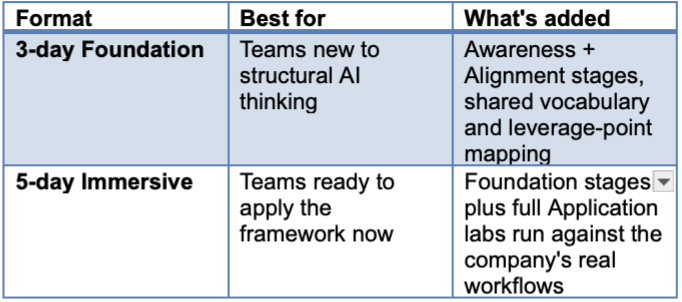
Both formats are 100% HRD Corp claimable under Vision Building's standard programme structure, and group sizes flex from a single department cohort up to a full cross-functional leadership group.
Search for AI training in Malaysia and the results are almost entirely tool-specific: prompt engineering, Copilot workflows, dashboard building, generative-AI courses tied to a particular platform. That content has a shelf life it goes stale the moment the tool's interface changes.
A structural thinking framework doesn't expire on the same schedule. "Think in Systems. Lead through Complexity" is designed to transfer across departments and across whichever AI tools a company adopts next year, because it trains the decision layer above the tool, not the tool itself. It also sits inside Vision Building's broader Vision-Instilled Methodology the same thread that runs through its team building and training programmes so leadership teams aren't learning AI thinking in isolation from how the rest of the organization operates.
Every cohort leaves with a leverage-point map specific to their own teams not a generic slide deck, but a working document built from the scenarios raised during the Application labs. That map typically names three to five decisions where AI is already changing the calculus, along with an agreed owner for revisiting each one during the Practice stage that follows the formal workshop days.
For companies that want to keep building on that momentum, the natural next step is pairing this programme with organizational development coaching, which works on the systems and culture layer the AI framework depends on to actually stick a leverage-point map is only useful if the surrounding organization is set up to act on it.
A leadership team that can only say "we sent people on an AI course" has a weaker answer to a board than one that can point to specific decisions a forecasting process, a proposal-review step, a client-facing workflow that changed because of it. That's the practical difference structural thinking makes over tool fluency: it produces a story about how the business operates differently, not just a certificate of attendance.
It also holds up better against the pace of change in the AI tools themselves. A course built around a specific platform needs to be repurchased or refreshed every time that platform's interface changes meaningfully; a framework for spotting leverage points and aligning departments around AI-assisted decisions works the same way regardless of which specific tool a company is using next year.
The programme works best with a cohort large enough to represent genuine cross-functional perspective, but small enough that the Application labs can work through real scenarios in depth rather than skimming the surface. In practice that tends to mean a single leadership team, a departmental cluster of senior managers, or a curated high-potential cohort — rather than an all-staff rollout, which dilutes the Alignment stage's usefulness.
Companies that have run this programme more than once often start with a smaller senior cohort in the first year, then extend the 3-day Foundation format to a wider group of managers once the leadership team has already built the shared vocabulary and leverage-point map that the wider rollout can build on.
None of this means tool-specific AI courses are unnecessary a team still needs to know how to actually use whatever AI software it adopts. The point is sequencing: tool training teaches the how, while the A.I. Training Programme teaches the when and whether. Companies that run tool training without ever addressing the decision-making layer often end up with staff who are technically capable but operating without any shared standard for when AI output should be trusted versus double-checked, which creates inconsistency that shows up later as a governance or quality problem rather than a training gap.
Because the Application stage is built from each company's own workflows, the specific labs vary by industry, but a few patterns come up often enough to be worth naming. A finance team might work through a lab on how much of a credit-risk assessment should be AI-assisted versus reviewed manually, and where the line between the two should sit. A manufacturing operations team might work through a lab on AI-assisted demand forecasting, specifically deciding which decisions the forecast should inform automatically versus which still require a human sign-off given the cost of getting it wrong.
A professional-services or agency team might instead work through a lab on client-facing AI use — how much of a client proposal can be AI-drafted before it needs to be disclosed, and what the firm's own standard should be, since different clients may have different comfort levels. In every case, the lab isn't teaching the tool used to do the task; it's forcing the leadership team to agree, out loud, on where the decision boundary sits — which is usually the part no one had actually discussed before the workshop.
Is the A.I. Training Programme only for IT or tech leaders?
No. It's built for leadership teams, senior managers, and cross-functional cohorts who make decisions AI is already influencing — no coding or technical background is required.
How is this different from a ChatGPT or Copilot training course?
Tool courses teach software skills that go out of date with the next update. This programme teaches a structural decision-making framework (the 3A+P Framework) that stays useful across whichever AI tools the company adopts next.
Is Vision Building's A.I. Training Programme HRD Corp claimable?
Yes, both the 3-day Foundation and 5-day Immersive formats are 100% HRD Corp claimable, in line with Vision Building's other corporate training programmes.
How long does the programme take?
Two formats are available: a 3-day Foundation programme covering Awareness and Alignment, or a 5-day Immersive programme that adds full Application labs built around the company's own workflows.
Ready to move your leadership team from AI awareness to AI-driven decision-making? Get started with a proposal for the A.I. Training Programme, or explore the full Corporate Training suite.